



Apple is about to change the conversation around iPhone battery life — for real this time. The iPhone 18 Pro Max battery is shaping up to be the biggest upgrade in the device’s history, and the numbers are hard to ignore. If charging anxiety has kept you from going all-in on an iPhone, the 2026 flagship may finally be the phone that puts that anxiety to rest. In this guide, we break down everything known about the iPhone 18 Pro Max battery — capacity, life, charging speeds, efficiency gains, and how it stacks up against the competition.
What Is the iPhone 18 Pro Max Battery Capacity?
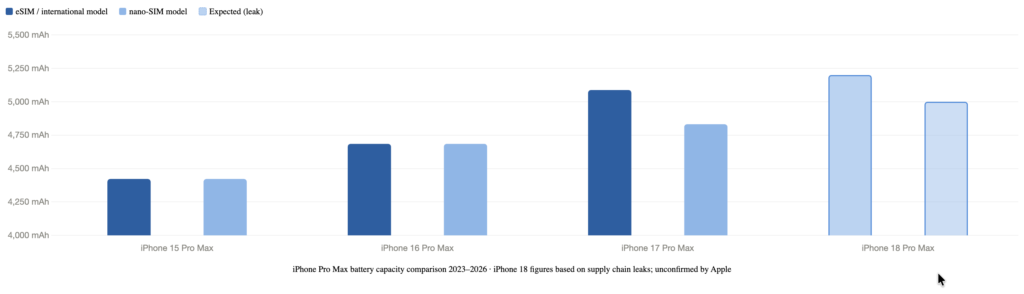
The iPhone 18 Pro Max battery is expected to pack a 5,100–5,200 mAh cell in international eSIM-only models, with the nano-SIM variant coming in at approximately 5,000 mAh. This would make it the largest battery Apple has ever shipped in an iPhone, surpassing the iPhone 17 Pro Max’s 5,088 mAh eSIM cell.
The leak comes from supply chain tipster Digital Chat Station — a Weibo-based source with a credible track record on Apple hardware — and has since been corroborated by multiple analysts and supply chain reports as of early 2026.
To put the growth in perspective:
- iPhone 15 Pro Max: ~4,422 mAh
- iPhone 16 Pro Max: ~4,685 mAh
- iPhone 17 Pro Max: ~5,088 mAh (eSIM)
- iPhone 18 Pro Max (expected): ~5,100–5,200 mAh (eSIM)
The year-over-year jump is modest in raw percentage terms — roughly 2% on capacity alone — but the real story isn’t the number on the battery label. It’s what the A20 Pro chip does with it.
How Long Will the iPhone 18 Pro Max Battery Last?
Based on current leaks and efficiency projections, the iPhone 18 Pro Max is expected to deliver over 40 hours of mixed-use battery life — up from Apple’s official claim of 39 hours for the iPhone 17 Pro Max.
For heavy users, that translates to a realistic 1.5 to 2 full days of use before needing a charge. Everyday tasks like streaming, browsing, and messaging could comfortably run across two days without hitting the charger.
This projection isn’t based on capacity alone. The A20 Pro chip, built on TSMC’s 2-nanometer process, is rumored to deliver 15–30% better power efficiency than the current A19 Pro. Apple’s first in-house C2 5G modem — also expected to debut with the iPhone 18 lineup — further reduces the power drain that 5G connectivity has historically imposed on battery life.
Combined, these two hardware changes could deliver dramatically better real-world endurance even if the battery cell itself only grows by a small margin.
The A20 Pro Chip: Why It Changes Everything
The A20 Pro chip is Apple’s next-generation processor, built on TSMC’s advanced 2-nanometer fabrication process. It is the successor to the A19 Pro found in the iPhone 17 Pro and Pro Max, which itself was manufactured on a 3-nanometer process.
Here is why the A20 Pro matters for battery life:
- Smaller node = lower power draw. Each generation of TSMC’s manufacturing process reduces the energy required to execute the same workload. Moving from 3nm to 2nm is a significant leap.
- Apple Intelligence efficiency. On-device AI processing — which powers features like enhanced Siri, photo tools, and predictive text — will run more efficiently on 2nm silicon, reducing background power consumption.
- Thermal performance. A more efficient chip generates less heat, which means the processor can sustain higher performance levels for longer without throttling — reducing the battery drain spikes that come with thermal management.
- C2 modem integration. Apple’s first fully in-house C2 5G modem is designed to work in tight integration with Apple’s chip architecture, unlike the Qualcomm modems used in earlier models. Tighter integration typically means less redundant power consumption.
According to MacRumors, the combination of the larger battery and A20 Pro efficiency improvements means the iPhone 18 Pro Max should “comfortably offer over 40 hours of battery life.”
iPhone 18 Pro Max vs. Android Rivals: How Does Battery Compare?
Raw battery capacity is one area where Android flagships have traditionally held an advantage. Here is how the iPhone 18 Pro Max stacks up against its 2026 rivals based on current leaks:
iPhone 18 Pro Max: 5,100–5,200 mAh (eSIM) — Apple’s largest ever, with class-leading software-hardware optimization.
Samsung Galaxy S26 Ultra: Most consistent leaks point to 5,000 mAh, consistent with Samsung’s recent flagships. Samsung’s Snapdragon 8 Elite Gen 5 offers strong efficiency gains, but real-world endurance tests on Galaxy S-series models have historically trailed Apple’s Pro Max line in video and mixed-use benchmarks.
Google Pixel 11 Pro / Pro XL: Expected to range from 4,870–5,200 mAh. Google’s Tensor G6 chip emphasizes AI power management, but Pixel devices have typically landed behind both Apple and Samsung in sustained battery life tests.
For context, Apple’s iPhone 17 Pro Max already topped many independent battery rankings despite having a comparable or smaller capacity than Android rivals — a testament to iOS and Apple silicon efficiency. The iPhone 18 Pro Max looks positioned to widen that advantage in 2026.
Some Chinese Android manufacturers — like Honor — have pushed batteries toward 10,000 mAh in gaming-focused devices, but these are not direct competitors to the iPhone 18 Pro Max in the premium flagship segment.
Charging Speed: Will iPhone 18 Pro Max Finally Catch Up?
Charging speed has long been a weak point for iPhones compared to Android flagships. While Samsung offers 45W wired charging and many Chinese brands go well beyond 100W, Apple has historically capped iPhone charging at lower wattages.
Early 2026 reports suggest the iPhone 18 Pro Max could bring Apple’s fastest-charging speed yet, narrowing — though likely not eliminating — the gap with Android competitors. Specific wattage figures have not been confirmed in reliable leaks as of this writing.
What is known:
- The iPhone 17 Pro Max supports 27W wired charging.
- The iPhone 18 Pro Max is expected to improve on this figure, though a dramatic leap (e.g., to 60W+) remains unconfirmed.
- MagSafe wireless charging and reverse wireless charging support are expected to continue.
For users who prioritize quick top-ups, this remains an area to watch as more hardware details emerge closer to the fall 2026 launch.
Design Change: Why the iPhone 18 Pro Max Is Getting Thicker
To accommodate the larger battery, the iPhone 18 Pro Max is expected to be slightly thicker than its predecessor. Reports from early 2026 put the device at 8.8mm — up from 8.75mm on the iPhone 17 Pro Max.
That is a minimal real-world difference, but it signals a deliberate shift in Apple’s design philosophy. For years, Apple prioritized thinness to a degree that constrained battery capacity. The iPhone 18 generation suggests Apple is willing to trade a fraction of a millimeter to meaningfully improve battery performance.
Rumored weight is over 240 grams — making it Apple’s heaviest flagship yet. For many users, that is a fair trade for multi-day battery life.
Display sizes are expected to remain unchanged at 6.9 inches for the Pro Max, with the same LTPO+ display technology that uses variable refresh rates to conserve power during low-motion content.
When Does the iPhone 18 Pro Max Launch?
The iPhone 18 Pro Max is expected to launch in September 2026, alongside the iPhone 18 Pro and Apple’s first foldable iPhone. This follows Apple’s traditional fall release schedule.
Notably, Apple is breaking from its usual pattern this cycle — the standard iPhone 18 and iPhone 18e will not launch until spring 2027. The fall 2026 lineup will focus exclusively on premium models.
Pricing is expected to remain consistent with the iPhone 17 Pro Max, which started at $1,199, according to analyst Ming-Chi Kuo. Apple is reportedly absorbing increased chip manufacturing costs to avoid raising consumer prices.
Frequently Asked Questions
Q: What is the iPhone 18 Pro Max battery capacity? The iPhone 18 Pro Max is expected to feature a 5,100–5,200 mAh battery in eSIM international models, and approximately 5,000 mAh in models with a nano-SIM slot. These figures come from supply chain leaks by Digital Chat Station, corroborated by multiple analyst reports as of early 2026. Apple has not officially confirmed any specifications ahead of the anticipated September 2026 launch.
Q: How long does the iPhone 18 Pro Max battery last? Based on current leaks and efficiency projections, the iPhone 18 Pro Max is expected to deliver over 40 hours of mixed-use battery life. For heavy users, this could translate to 1.5 to 2 full days on a single charge. This improvement is driven by both the larger battery cell and the dramatically more efficient A20 Pro chip built on TSMC’s 2-nanometer process.
Q: What chip does the iPhone 18 Pro Max use and how does it affect battery life? The iPhone 18 Pro Max is expected to use the A20 Pro chip, built on TSMC’s 2-nanometer manufacturing process. This chip is rumored to deliver 15–30% better power efficiency than the A19 Pro in the iPhone 17. Combined with Apple’s first in-house C2 5G modem, the A20 Pro could significantly extend real-world battery life beyond what the capacity increase alone would suggest.
Q: How does the iPhone 18 Pro Max battery compare to Samsung Galaxy S26 Ultra? The iPhone 18 Pro Max is expected to have a slightly larger battery (5,100–5,200 mAh) than the Samsung Galaxy S26 Ultra (rumored at 5,000 mAh). More importantly, Apple’s tight hardware-software integration has historically allowed iPhones to outperform Android rivals in real-world battery tests despite comparable or smaller capacities. The iPhone 17 Pro Max already ranked as one of the longest-lasting smartphones tested in independent lab results.
Q: Will the iPhone 18 Pro Max have faster charging? Yes, the iPhone 18 Pro Max is expected to offer improved charging speeds over the iPhone 17 Pro Max, which supports up to 27W wired charging. Specific wattage figures for the 18 Pro Max have not been confirmed in reliable leaks yet, but reports suggest Apple is working to narrow the gap with Android competitors. MagSafe wireless charging is also expected to continue.
Q: When will the iPhone 18 Pro Max be released? The iPhone 18 Pro Max is expected to launch in September 2026, following Apple’s traditional fall release schedule. It will debut alongside the iPhone 18 Pro and Apple’s first foldable iPhone. The standard iPhone 18 and iPhone 18e are not expected until spring 2027 in a departure from Apple’s usual simultaneous lineup launch.
Conclusion: Is the iPhone 18 Pro Max Battery Worth the Wait?
The iPhone 18 Pro Max battery represents one of the most meaningful upgrades Apple has delivered in years — not because of a dramatic leap in capacity, but because of the combination of a record-breaking cell, a generational chip efficiency jump, and an in-house modem designed to minimize power waste. If the leaks hold, the iPhone 18 Pro Max could finally silence the criticism that iPhones lag behind Android on endurance.
Whether you are upgrading from an iPhone 15, 16, or even 17, the 2026 Pro Max looks like the most compelling battery story Apple has told in a long time. For the latest confirmed specs, watch Apple’s fall 2026 event.
[Internal link: Compare iPhone models → iPhone comparison guide] [Internal link: iPhone 18 Pro features → iPhone 18 Pro roundup] [External link: MacRumors iPhone 18 Pro Max roundup → macrumors.com]